

For Data Protection Officers
- Home
- GRC Solutions
- For Data Protection Officers
DPDP Compliance Without Building Everything From Scratch
The Act is new. The rules are still evolving. You need a system to manage obligations, not just track them in spreadsheets.
The reality of operationalizing DPDP
The DPDP Act created a new compliance obligation. But most organizations don't have infrastructure built for it. DPOs are operationalizing privacy programs with tools designed for something else.
1
No system of record
Processing activities documented in spreadsheets. Consent records scattered. DSR requests tracked over email. No single source of truth.
2
Cross-functional coordination
DPDP touches IT, legal, HR, marketing, customer service. You're accountable, but you don't control the teams doing the work.
3
Evolving requirements
Rules are still being clarified. What's compliant today may not be tomorrow. You need a system that can adapt, not a static checklist.
4
Audit exposure
When the Data Protection Board comes asking, you need evidence. Timestamped. Complete. Not reconstructed after the fact.
What changes with eQomply
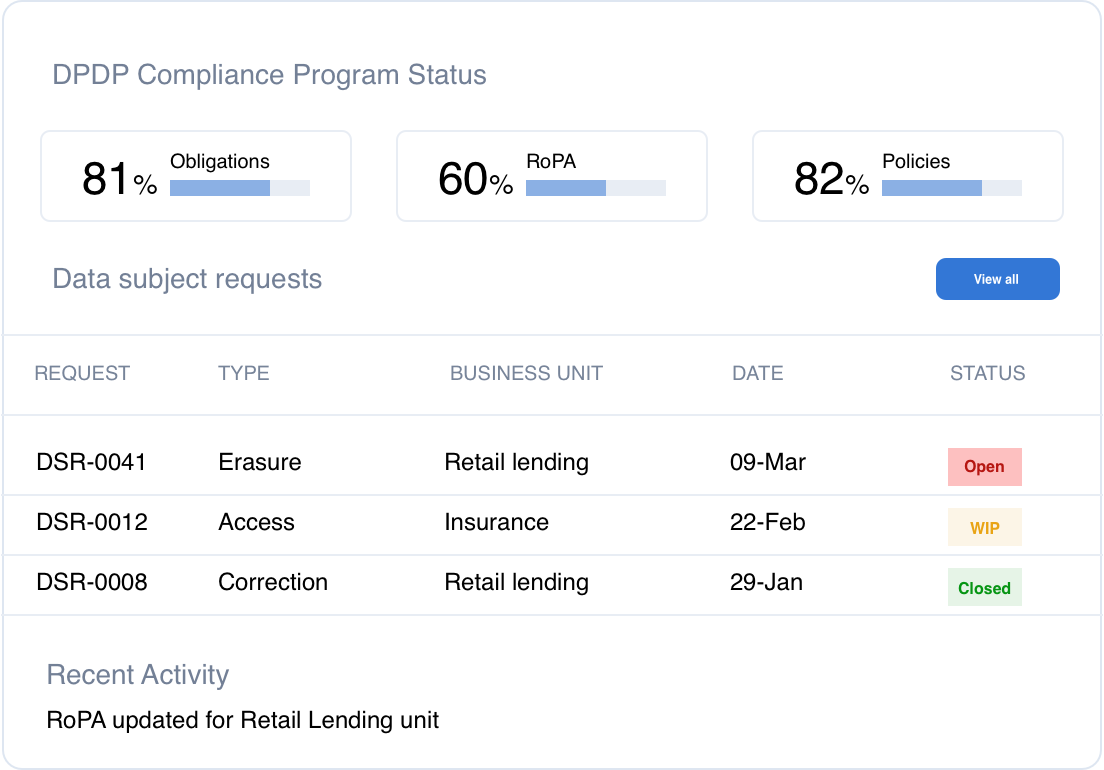
eQomply gives DPOs the infrastructure to operationalize DPDP. Obligations tracked, evidence captured, workflows built in. Not bolted onto tools designed for something else.
DPDP obligations mapped and tracked
Requirements translated into tasks. Assigned to owners. Tracked to completion. All in one place.
Records of Processing Activities (RoPA)
Centralized, structured, exportable. Not buried in a spreadsheet somewhere.
Data Subject Request (DSR) workflows
Requests logged, routed, tracked. Audit trail from receipt to closure.
Policy governance for data protection
Privacy policies versioned, attested, linked to DPDP requirements. Evidence of communication built in.
Evidence ready for audit
Everything timestamped. Everything traceable. When the DPB asks, you're ready.
Cross-functional task assignment
DPDP obligations span IT, legal, HR, marketing. Assign tasks to owners across functions. Track completion without chasing over email.
Use Cases
See how this works in practice
A data subject requests access to their data. The request is logged, routed to the right team, tracked to completion. Response time documented. Audit trail complete.
Processing activities updated as new projects launch, as vendors change, as data flows evolve. Not a once-a-year exercise.
The Data Protection Board requests evidence of compliance. You export the records. Timestamped. Organized by requirement. No scramble.
See how eQomply works for data protection teams
A walkthrough tailored to your DPDP compliance program.